Wednesday, 4 August 2010

Bees | Fiction | Royal Jelly - Critical Consensus and Counter-Consensus

I think of bees and fiction, and the first image that crops into my head is that of Roald Dahl’s Twilight Zone story, ‘Royal Jelly’. The story’s simple; a father who’s also an obsessive beekeeper starts feeding his newborn daughter the bees’ nutrition-rich ‘royal jelly’, as many fathers still do (you can also put it in your hair; in either case, if you’re allergic to it you may die, so I wouldn’t personally recommend it). Daughter turns into a queen bee.


Cosmetic product users, beware; you could end up as adorable as this.


I had written an article for this week where I went on from here to discuss the photo of a model who’d been hired to dress as a wasp at one of this year’s hugely popular American comic book festivals, and went on to talk about the ordinary people who dress up as fictional characters they admire, trying to eat the royal jelly of the coolness, sexiness, and individuality of, say, the Joker or Jack Sparrow, and become that character by association. By doing so, I said, they were in danger of killing their own true individuality. It was a pretty good article. Sadly, it had little to do with bees and less to do with fiction, so I scrapped it, and I’m going to discuss Gabriel Josipovici’s now-notorious comments about Salman Rushdie, Philip Roth and Julian Barnes being “hollow.”


If there’s one sort of literary-based article I’ve come to loathe, it’s the ‘Everybody, look! A moderately well-known writer or academic has dared to impugn a member of our beloved literary canon’ announcement, which from Roddy Doyle slagging off Ulysses to Josipovici calling Barnes “smart-alec, slightly anxious”, never deviates in style. It always has the exact tone of the sort of schoolchild who’s heard one of his peers say something a bit silly and can’t wait to tell the rest of the class so they can all mock together.

“Oh my God, Gabriel- I can’t believe you said that! Guys! Guys! You’ll never guess what Gabriel said!”
Let’s save the ‘decline of literature’ implications of Josipovici’s words for another day (though they would have fitted well with the decline of the honeybee) and concentrate on what he said about the authors “showing off” and “an ill-educated public being fed by the media – this is what art is.” He goes on to wonder why writers like Rushdie feel the need to boast and shock. Ignore the elitism and let’s remind ourselves that the authors, as well as the public, are being fed royal jelly by the hive of literati. And, honestly, glancing back over the sort of royal jelly they’ve received over the years, you’d have to be horribly arrogant to think that you could possibly avoid being affected by any of it.
“Will Barnes ever write a dull or mediocre novel?”


“Every sentence and every paragraph works with the coiled precision of the watch mechanisms that the narrator's father repairs, and glitters with the lapidary perfection of the diamonds he sells.”


“[Saturday] offers a detailed portrait of an age, of how we live now, and... it offers more, something transcendent, impossible to dissect.”

And then there’s the New York Times Book Review review that puts Rushdie in the company of Swift, Voltaire, and Sterne. (Incidentally, Metacritic has a books section. Who knew?)
I don’t want to speak for the authors themselves, but I do wonder if even Kafka could have kept his insecurity secure when he was being told this sort of thing. Self-satisfaction is built on self-doubt, and, as writers, we are constantly in dialogue with our readers, whether we claim otherwise or not. And, because we’re largely insubstantial creatures, their reaction is always going to affect us, even reshape us. We want to be outsiders, but we do long for the approval of the hive; we want, above all, to be heard by them. If Beckett had been as “damned to fame” as he clearly enjoyed claiming, then why publish in the first place? Why did B.S. Johnson cling, desperately, to one critic’s assertion that he was “one of the best writers we’ve got”, repeating it in covering letter after covering letter to uninterested publishers? Did even Allen Ginsberg really want to break out of the mainstream alone, so much as create his own edge-group?


I decided to put up a photo of the wasp-lady anyway.  Unless she is a bee.  Is that the Transformer behind her that's meant to be like a bee?  Why does the Transformer species even know about bees?  God, I'm so confused.

Only true literary royalty can accomplish that paradox of being one of the people, being their representative, their voice, being appreciated by them, while also being alone and apart.  It’s queen bee or nothing, for a writer. And, most interestingly as far as this metaphor goes, hive members have been known to “cuddle” their queen to death, pressing their bodies around her and suffocating her. Hive = critics, queen = writers established in the canon; geddit? Geddit?
Additionally, there are many potential queens, but it’s only the one who sleeps with the hive that reigns supreme. And these potential “virgin queens” like to try and kill each other. I was amused by the Literary Encyclopaedia’s winningly objective entry on Josipovici;

“Gabriel Josipovici is one of the major contemporary British authors. If this fact has so far escaped the notice of British literary critics and much of the British public, this is no doubt due to Josipovici's denigration as 'merely' an “experimentalist”.”

So this becomes, in my mind, an issue of a member of the counter-culture movement scoffing at the mainstream – and he couldn’t have chosen any more mainstream authors, you note, to attack. (Is it my imagination, or are the worldwide media making this sort of contrarian thing more prevalent? A book wins the Prix Goncourt, Michiko Katutani shoots it down. To Kill A Mockingbird has an anniversary, we hear it may not have been all that, and immediately read a counter-article stating that, actually, it was. Armond White seems to have built an entire career out of doing this.)

Yes, readers are affected by critics who tell them what art is; and critics who tell them what art isn’t. So are writers. All of us enjoy forming tribes rather than opinions. The Internet has a wonderful, crass name for this- it’s called ‘circlejerk’. You sit in a circle with your friends who all agree with you, and you, er...jerk, communally. Rushdie will have his circlejerking hive, and Josipovici will have his. But what the latter should not do is posit himself as a lone voice speaking out against the hive mind of literary criticism when he’s a wannabe queen bee as well. He isn’t literature’s new saviour against Rushdie and co., but another voice, yelling into the sea of voices.

Tuesday, 3 August 2010

Things That Benedict Cumberbatch’s Face Looks Like – part three

We were going to go with a third-degree-burns victim, but decided this might be considered more tasteful/respectful/etc. Also, when one google image-searches the words, 'burns victim,' pictures of Pete Burns come pretty high up. Make of that what you will.

Part three: Pete Burns


Cumberbatch


Burns

Bees | Poetry | Wintering


It is difficult not to use ‘bees’ and ‘poetry’ in the same sentence without thinking of Sylvia Plath. Under interview she suggested that it was Ted Hughes that forced her to embrace her fixation upon the image of her father’s beekeeping.


Fear not, I do not intend to give you a cod-Freudian interrogation of ‘Ariel’… there is enough of that swarming around out there to satisfy any apiculturist readers of poetry.


I would simply like to share with you my favorite Plath poem, Wintering.


All poets have their individual strengths, and for me, Plath’s is her ability as a generator of images. Images that hold you and appall you and unsettle you and fill us with familiarity and disgust. Delving into Plath’s later poetry often feels like throwing an Easter egg against a wall to see it explode with maggots.


Of all the knock-you-off-your-feet imagery Plath has melded into her poems, there is an image, an idea, in ‘Wintering’ that has stuck with me with hypnotic clarity since the first time I read it, around 4 years ago.


This is the time of hanging on for the bees - - the bees

So slow I hardly know them,

Filing like soldiers

To the syrup tin


To make up for the honey I’ve taken.

Tate and Lyle keeps them going,

The refined snow.


Part of the reason this image stuck with me so clearly is Plath’s use of ‘Tate and Lyle’… an exceptionally rare use of an ephemeral brand name in a body of work which otherwise strives for an otherworldly, timeless quality. It feels like an interjection from the modern-world amidst an ancient ritual – a police siren wailing over Claire de Lune perhaps.


But it’s the idea behind the image that bares so much fruit in this poem. When I first read this poem I was sat in a library full of underslept academics gazing into the gaudy glow of their laptops. They were flicking frantically through all manner of text-books and literary theory, trying desperately to manufacture that artifice of originality in the over-farmed soils of literary theory.


Whilst doing this, they were doubtless keeping a weather-eye on an instant-messaging window, sifting through electronic versions of literary journals, hunting down publication dates with which to cite that sting-in-the-tail quotation they have been saving for their essay conclusions.


I was doing the same.


And I got to thinking about the most important ideas of all humankind coming from sitting under a tree, or getting into a bath, or Paul McCartney writing ‘Yesterday’ whilst making himself some scrambled eggs.


The human as bee, then. When was the last time we experienced honey? For how long has the Tate and Lyle kept us going? What do I have to do to experience the real thing?


Plath knew more than most of her time, how we medicate ourselves to maintain the equilibriums we aspire to, be it with aspirin or cigarettes, antibiotics or cocaine. In Wintering we have that horrifying idea of the human ability to spread this dependence indefinitely – by turning a swarm of bees into her basement into syrup junkies.


I hope that you enjoy her poem as much as I do.


Wintering by Sylvia Plath


This is the easy time, there is nothing doing.

I have whirled the midwife's extractor,

I have my honey,

Six jars of it,

Six cat's eyes in the wine cellar,


Wintering in a dark without window

At the heart of the house

Next to the last tenant's rancid jam

and the bottles of empty glitters ----

Sir So-and-so's gin.


This is the room I have never been in

This is the room I could never breathe in.

The black bunched in there like a bat,

No light

But the torch and its faint


Chinese yellow on appalling objects ----

Black asininity. Decay.

Possession.

It is they who own me.

Neither cruel nor indifferent,


Only ignorant.

This is the time of hanging on for the bees--the bees

So slow I hardly know them,

Filing like soldiers

To the syrup tin


To make up for the honey I've taken.

Tate and Lyle keeps them going,

The refined snow.

It is Tate and Lyle they live on, instead of flowers.

They take it. The cold sets in.


Now they ball in a mass,

Black

Mind against all that white.

The smile of the snow is white.

It spreads itself out, a mile-long body of Meissen,


Into which, on warm days,

They can only carry their dead.

The bees are all women,

Maids and the long royal lady.

They have got rid of the men,


The blunt, clumsy stumblers, the boors.

Winter is for women ----

The woman, still at her knitting,

At the cradle of Spanis walnut,

Her body a bulb in the cold and too dumb to think.


Will the hive survive, will the gladiolas

Succeed in banking their fires

To enter another year?

What will they taste of, the Christmas roses?

The bees are flying. They taste the spring.


*


Phil Brown
Poetry Editor

Monday, 2 August 2010

Bees | Introduction | The Language of Mead


Week 11 | Bees | Contents


Tuesday | Poetry | Wintering
Thursday | Music | Blow Job Betty
Friday | Chapbook | There There, by Daniel Payne


A city is a place where there is no need to wait for next week to get the answer to a question, to taste the food of any country, to find new voices to listen to and familiar ones to listen to again.
Margaret Mead

Mead is one of those ancient things, deeply old and established in so many cultures around the word. It is The Great Grandmother of All Fermented Drinks. As a result it holds a certain position in the market of language, with ‘fingers in many pies’. A great thing for those that take pleasure in the discovery of new pools of language.

You can see the full list of variants of mead here. However, below is a short-list of words you probably haven’t heard of before – ready for you to slip into any mead related conversation – or a poem perhaps.

•    Acerglyn — A mead made with honey and maple syrup.
•    Bochet — A mead where the honey is caramelized or burned separately before adding the water. Gives toffee, chocolate, marshmallow flavors.
•    Braggot — Braggot (also called bracket or brackett). Originally brewed with honey and hops, later with honey and malt — with or without hops added.
•    Capsicumel — A mead flavored with chile peppers.
•    Cyser — A blend of honey and apple juice fermented together; see also cider.
•    Hydromel — Hydromel literally means "water-honey" in Greek. It is also the French name for mead. (Compare with the Spanish hidromiel and aquamiel, Italian idromele and Portuguese hidromel). It is also used as a name for a very light or low-alcohol mead.
•    Melomel — Melomel is made from honey and any fruit. Depending on the fruit-base used, certain melomels may also be known by more specific names
•    Metheglin — Metheglin starts with traditional mead but has herbs and/or spices added. Some of the most common metheglins are ginger, tea, orange peel, nutmeg, coriander, cinnamon, cloves or vanilla. Its name indicates that many metheglins were originally employed as folk medicines. The Welsh word for mead is medd, and the word "metheglin" derives from meddyglyn, a compound of meddyg, "healing" + llyn, "liquor."
•    Morat — Morat blends honey and mulberries.
•    Mulsum — Mulsum is not a true mead, but is unfermented honey blended with a high-alcohol wine.
•    Omphacomel — A mediæval mead recipe that blends honey with verjuice; could therefore be considered a variety of pyment (qv).•    Oxymel — Another historical mead recipe, blending honey with wine vinegar.
•    Pyment — Pyment blends honey and red or white grapes. Pyment made with white grape juice is sometimes called "white mead."
•    Rhodomel — Rhodomel is made from honey, rose hips, petals or rose attar and water.


James Harringman
Editor-in-disbelief

Death To The Meme - Empire States of Parody.

I was charmed, today, by the Alex Warren/Temera Wainwright Welsh parody of Jay-Z/Alicia Keys' 'Empire State of Mind', 'Newport State of Mind'.  The 'comedy Welsh rapper' thing takes a few minutes to disassociate itself from GLC, but still.

Though, being an enormous nerd, my heart has to lie with CollegeHumour's Star Wars-themed parody, 'Galactic Empire State of Mind'.  For one thing, the singers both actually do an astonishing impersonation of their targets, and anyone who doesn't think Darth Vader rapping while Imperial Stormtroopers breakdance and Princess Leia plays that weird blue elephant's keyboard thing has never had a childhood.


A meme gets off to a good start.

But I am afraid of the Internet parody, for it spawns more parodies.  'Newark State of Mind', 'Minnesota State of Mind', 'DC State of Mind', 'Jewish State of Mind' - all of them take the original's lyrics and replace them with in-joke references to their hometown...or, in the last case, their religious culture.  The worrying thing is that I can't place exactly why these should be any less funny than the 'original' parodies, if only that I saw them afterwards.  The joke wears out fast.

So beware; 'Newport' has just been mentioned in the Guardian, which means there'll be more small-town parodies on the way, each one butchering the humour more and more.  Swindon State of Mind.  Weston-Super-Mare State of Mind.  I am already troubled by a repeated Youtube comment left by 'Mr Maraxx3' - "Not much, Czech parody ore from Ostrava - Ostrava is better".  Yes, Mr Maraxx, I feel certain people worldwide will be chuckling at the zingers concerning Ostrava's coal deposits and candidacy for European Capital of Culture 2015.


A meme doesn't.

Neither is this eternal, hellish Internet repetition of songs a new problem.  I'm sure we all remember the amateur parodies of the Lonely Island's already awful, one-joke R & B parody, 'I'm On A Boat', which I will not link here, lest by clicking on the Youtube video, I end up indirectly supporting them.  'I'm On A Float', 'I Need Your Vote', and the now-notorious 'I'm On A Couch'.  (Which actually seems to have been made twice, for no reason that I can fathom.)  Cheeseburgerz are funnier than this.  Cheeseburgerz.

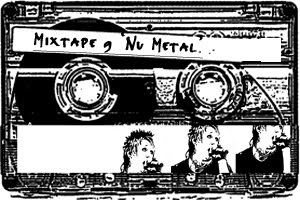
Butterflies | Mixtape | Mixtape IX, 'Nu Metal: A Critical Re-reading' by Greg Dwan


Music As Reading: Mixtape IX, Nu Metal: A Critical Re-reading (by Greg Dwan)

*Many, many thanks to Greg Dwan for this, the first in a series of superb guest mixtapes.*

Between Angels and Insects – Papa Roach [Infest, 2000]
Essentially Jacoby Dakota Shaddix, or ‘Coby Dick’ as he was known at the time, shouting quotes from Fight Club over the opening riff of Prowler by Iron Maiden: “Working jobs that you hate for shit you don’t need” and “the things you own, own you”. Fred Durst may have “seen Fight Club about 38 times”, but perhaps he’d have a better reputation as a lyricist if Chocolate Starfish and the Hot Dog Flavored Water opened with his wondering what kind of dining set defines him as a person.

Down With the Sickness – Disturbed [The Sickness, 2000]
Featuring the greatest mid-song rhythmic dramatic monologue ever set to wax.

Daydreams – (hed) PE [Only In Amerika, 2005]
“Hey man, here’s a little love song for all you little bitches” – while the irony that soaks through all of (hed) PE’s career, intentionally or not, is present in this song in bucket loads from start to finish, the chorus is lifted directly from W.B.Yeats’ ‘He wishes for the cloths of Heaven’: “I would give you anything / But I don't have anything / Just these crazy daydreams / and they are not worth anything”. In an album that also features the repeated backing vocals: “If I suck your dick will you put it inside me?” Jared Gomes is asking you to tread softly because you tread on his dreams.

This Is Not – Static-X [Machine, 2001]
The sound of a man with huge spiky hair having a violent existentialist breakdown.

Youth of the Nation – P.O.D [Satellite, 2001]
P.O.D managed to get this out before both Bowling for Columbine and Kelly Rowland’s solo effort “Stole” based on the same message, proving not only that they were quicker on the uptake with the artistic cashing in on Columbine fever, but that they were also much more literate lyricists. “Instead of taking the test I took two to the chest” may not go down as the greatest school-shooting based line in history, but it’s leagues above Rowland’s effort: “His life was stole (Stole, Oh)” [sic].

Mutter – Rammstein [Mutter, 2001]
Mary Shelley’s Frankenstein has mummy issues. You’ll probably need a translation.

New Disease – Spineshank [The Height of Callousness, 2000]
A potent rephrasing of Albany’s couplet in King Lear, Act 1, Scene IV: “How far your eyes may pierce I can not tell: /Striving to better, oft we mar what's well.”

Nothing Gets Nothing – American Head Charge [The War of Art, 2001]
More Lear.

Across the Nation – The Union Underground [WWF Forceable Entry, 2002]
Nu Metal party beat poetry.

Holy Man – One Minute Silence [Buy Now...Saved Later, 2000]
Yap from OMS started a career as a slam poet and public speaker after the demise of the band. I assume his clichéd political ravings and catchy slogans sound just awful without funk metal blasting them forward.

Mudvayne – Death Blooms [LD:50, 2000]
DEEP SHIT.

My Oedipus Complex – Kid Rock [The History of Rock, 2000]
Kid Rock thinks he can get away with writing a song about how he never got on with his old man, give it this title, and completely avoid any reference to banging his own mum.

*NB: Alas, due to Spotify’s shortcomings, we had to go with a cover of Rammstein’s Mutter (by the gloriously name Völkerball) and a different One Minute Silence track. We went with Stuck Between a Rock and a White Face because, well, because it’s called Stuck Between a Rock and a White Face. Sorry Greg.*

Sunday, 1 August 2010

Things That Benedict Cumberbatch’s Face Looks Like – part two

Many thanks to Naomi Lewis for the following suggestion...

Part two: A Great Dane puppy


Cumberbatch


Puppy