Showing posts with label Dashiell Hammett. Show all posts

Saturday, 30 April 2011

Vincent Price | Film+Television+Radio | Art in the Blood

"Someone called actors 'sculptors in snow'. Very apt. In the end, it's all nothing." - Vincent Price


What a voice! Never mind that tall wide frame and that diabolic brow, what a voice! Vinegary and pointed, loaded with promise, it's the sound of the Snake in Eden.

Earlier this week, Phil Brown wrote of Price's magnificent readings of Poe. I offer this piece as an addendum, a glimpse of the other Vincent, before Corman and before Tim Burton. My Price is the Price of the '40s and the '50s, the smooth operator so often on the verge of hysteria. Look at his vapid gigolo in Laura (1944), clinging onto Judith Anderson after Dana Andrews has gut-punched him. Or his Shakespearean ham in His Kind of Woman (1951), baffling Bob Mitchum by complaining, "Alas! Why must I be plagued by yammering magpies on the eve of battle?" And was there ever an actor more suited to playing Cardinal Richelieu (1948), sneering haughtily at Gene Kelly's D'Artagnan?

Physically, Price called the opening of The Maltese Falcon to mind: "Samuel Spade's jaw was long and bony, his chin a jutting V under the more flexible V of his mouth. His nostrils curled back to make another smaller V. His yellow-grey eyes were horizontal. The V motif was picked up again by thickish brows rising outward from twin creases above a hooked nose, and his pale brown hair grew down - from high flat temples - in a point on his forehead. He looked rather pleasantly like a blond satan."

Temperamentally, however, Price was more the heir to George Sanders than to Bogie. Both were cultured and sardonic, and both had played Leslie Charteris' gentlemen adventurer The Saint, Sanders onscreen for RKO, Price for NBC Radio. Price's broadcasts as Simon Templar are breezy and fun, and he handles tough-guy dialogue with just the right sense of self-mockery. And even in these pulpy programmers, we get a glimpse of the man within - each episode ends with a small message from Price the actor, often addressing social concerns of the day. Bob Glickstein draws attention to the coda to Author of Murder in which Price speaks out against the "venom of racial and religious hatred" in '50s America.

While onscreen Price often played vulgarians (see 1950's Champagne for Caesar, in which he menaces the eminently civilised Ronald Colman), offscreen he was that rarest of things, an intellectual film star. Like Edward G. Robinson, he was a great art collector and was passionate about the humanities. In 1951, he donated 90 pieces from his collection, setting up the first 'teaching art collection' in an American community college.

I'll close with two favourite moments of Price ephemera. The first is an unsuccessful pilot entitled Collector's Item (1958), that teamed him with Peter Lorre as crime-fighting antique dealers. Yes, long before Lovejoy, Price and Lorre were risking life and limb in the pursuit of objets d'art. It's a crime that the studio nixed further episodes. Thankfully, the pilot lives on via Youtube!


Lastly, a scene that makes use not just of Price's voice, but of his singing voice. His Professor Rattigan is vain, devious and terrifying. And, despite all that other great work, it's his contribution to Basil the Great Mouse Detective (1986) that most strongly rebuffs the rather despondent claim that "In the end, it's all nothing." As with George Sanders and Shere Khan, as long as children watch Disney films, that voice will survive in memory. And perhaps they'll seek out further works by Vincent Price. That's something.

Saturday, 26 March 2011

China | Film+Television | Forget it, Jake.

"You may think you know what you're dealing with, but believe me, you don't."
Noah Cross, Chinatown (Roman Polanski, 1974, Paramount)

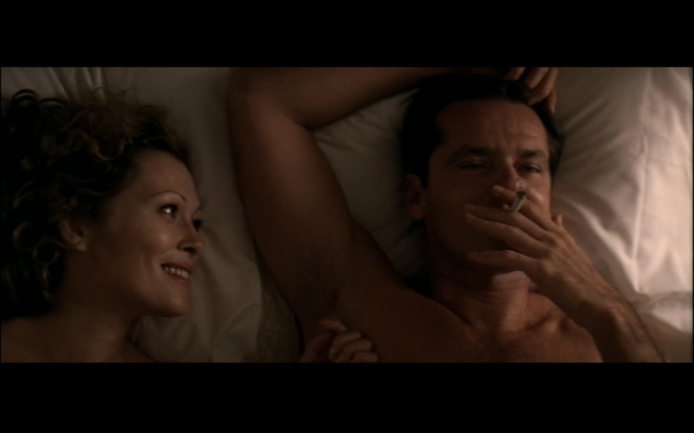
There is a famous shot in Chinatown that moves along Jack Nicholson's naked arm, stopping when it reaches his face resting on a pillow. At left of frame, Faye Dunaway watches his post-coital satisfaction. The scene is lit so that their skin seems golden, so that we bask in the beauty of their present moment. But, characteristically for the film, this moment is in thrall to an opaque past.

Dunaway asks Nicholson about his past as a beat cop, when he patrolled the streets of L.A.'s Chinatown. It is a painful memory: Nicholson's character, J.J. Gittes, tried to save a woman from getting hurt. By involving himself, he ensured that she was.

In Polanski's paean to the film noir, the space of Chinatown stands as a metaphor for the unknowable, the uncontrollable. But it also has a contemporary relevance which may not be immediately obvious.

Writing in Movie, Ed Gallafent observed that, "Chinatown is a locale rather than a human population, a context in which Americans find themselves in circumstances not of their own choosing and in which their actions and dreams are frustrated, but for reasons that cannot be made accessible, because the underlying order cannot be understood or represented. In this respect, we may take Chinatown exactly to anticipate the cycle of late 'seventies films overtly set in the Vietnam of the war, with their inability to articulate Vietnamese culture other than as an obscure background to American lives and actions."

It is only in the concluding scenes of the film that we reach Chinatown, and it is in this space that the tragic events of the finale play out. These fatal moments repay a promise that the film has made us - that Chinatown is inescapable, that while Gittes may think he has left his grubby past behind him, forgetting is futile and indeed impossible.

The Oriental space as maze features in a number of Hollywood films of the 80s that do not explicitly reference Vietnam - I am thinking specifically of Hammett (Wim Wenders, 1982, Zoetrope) and Big Trouble in Little China (John Carpenter, 1986, Twentieth Century Fox). These movies, far pulpier than Chinatown, evoke the Victorian anxieties of Sax Rohmer. Orientalist representation ensnares their all-American heroes in variant San Franciscos, depicting cities within cities where the rule of law is imposed by sons of Fu Manchu.

I was surprised to see a similar process at work in Steven Moffat and Mark Gatiss' Sherlock. In the second episode The Blind Banker (written by Stephen Thompson), the Baker Street duo found themselves in London's Chinatown. One of the precepts of the 2010 series was its assumption that viewers were 'in on the game'. We were supposed to congratulate ourselves for recognizing the references to Rohmer and to the 1977 Doctor Who serial The Talons of Weng-Chiang.

But Sherlock collapsed through its failure to justify a coherent world. If we are to understand that the appeal of the show lies in Sherlock's interaction with the modern world, why are these hoary old Si-Fan cliches cluttering up the place? The internal logic, and metaphorical weight, of Chinatown was missing. Only the stereotype remained, a small echo of a once-rich imagery.

Forget it, Jake...

Friday, 18 March 2011

Radio | Dialogue | Hammett Bends the Spoon

A few years ago, I wrote a radio play that retold Lillian Hellman's partial anecdotes of Dashiell Hammett. This is one of the scenes.

SCENE 4. INT. NIGHT. BEDROOM.

(Dash and Lily are in bed.)

LILY: Were you ever in real danger?

DASH: A few times. I’ve got a dent in my head.

LILY: How’s that?

DASH: Hit with a brick in a dark alley back in ’21.

LILY: (laughing) Ever shoot it out with gangsters?

DASH: Almost once a week.

LILY: I don’t think I believe you much.

DASH: I wasn’t a G-man. angel. Most Pinkerton work was sitting in cars, watching and waiting.

LILY: So how did you get the scars on your legs?

DASH: That was one time when a group of us were sent along to nab a gang that had been stealing dynamite. We broke into the house where they'd shacked up, but they were waiting for us. Someone must have given them the word. Anyhow, one of them sat on me while his friend started whittling away at my leg with a clasp knife.

(FX: Lily lights a cigarette.)

LILY: Got any other good Pinkerton stories?

DASH: All my stories are Pinkerton stories, sweetheart. That’s my problem.

LILY: So why did you quit?

DASH: Lots of reasons. I wanted to concentrate on my writing. And TB. The scars on my lungs were giving me hell. I wanted to concentrate on my breathing too.

(FX: The bedsprings creak as Lily gets out of bed.)

LILY: Time’s getting on. We ought to-

DASH: But I haven’t told you the best Pinkerton story of all yet.

LILY: Tell me when-

DASH: Sit down. You’ll want to hear this one.

LILY: (resignedly) Alright, OK.

DASH: When the regular police force took away a lot of the Pinkerton work, we used to get employed as union busters, strike breakers. In 1917, I got sent out to Butte, Montana. The Anaconda Copper Company was having trouble with a fellow called Frank Little. He was a labour union organizer – part Indian with only one eye but he knew how to work a crowd. He wouldn’t be bluffed or scared off. So an officer for Anaconda Copper offered me five thousand dollars if I would murder Frank Little.

(FX: He stops. Lily dare not speak.)

DASH: I went out on the next train but I heard afterwards that Little was lynched at a railroad crossing a few days later. Anaconda Copper didn’t have any trouble after that. Pretty, isn’t it?

LILY: They couldn’t have made you that offer if you hadn’t been a strikebreaker.

DASH: Yes ma’am. So why do you think I told you about it?

(A long pause.)

LILY: Get dressed. We don’t want to keep my husband waiting.

Nicolas Pillai
Film Editor