Showing posts with label John Berryman. Show all posts

Saturday, 26 February 2011

Silence | Music+Painting | Time Heals All Wounds, Time Heals All Tunes

I’ve posted this video on Silkworms before, during the Heathrow Airport debacle that ruined poetry editor Phil Brown’s Christmas – I figured then that Peter Broderick’s take on airport travel was more compassionate than, I don’t know, Brian Eno’s Music For Airports. But I’m posting it again because it also represents the most thrilling use of one of the most thrilling tropes available to the intelligent musician that I came across all of last year. Namely, a moment of absolute silence. A moment of absolute stillness that forms the centrepiece of a song – three minutes and thirty six seconds in, to be precise – and which has a profound impact on how one listens to what comes after it, and how one remembers what came before. Over to Peter:


There are a couple reasons why this particular silence smashed me between the eyes (insofar as silence can smash) so effectively the first time I heard it. The fact it follows immediately on from another extraordinary play on dynamics, the whispered refrain of ‘time heals all tunes.’ The fact I was lucky enough to be watching Peter live at the Union Chapel in Islington, a space which doesn’t so much host silence as gather it up, rolling it around its stonework and shadows until it has swelled to three times its original size.

But mostly because it is what it is, a seam of silence cut into the melodic core of a song. That is, a contemporary manifestation of an only-ever-half-expected spirit which has haunted pretty much every genre of music there has ever been, from Gregorian chants to jazz improvisations, blues rhythms to trance anthems – you know, when that breakdown happens, the one that goes beep beep beep beep beepbeepbeepbeep beeeeeeeeeeeeeeep *half-second’s silence* crash crash everybody’s dancing aren’t these narcotics splendid crash crash etc. etc. There’s an excellent piece, indeed, about ‘how a pause can be the most devastating effect in music’ over at Slate magazine, which does a decent job of tracing a chain of creative silences from Handel’s hallelujah chorus through to John Cage’s 4’33” via Wagner and, best of all, Debussy in Prelude to the Afternoon of a Faun, within which ‘the faun’s burgeoning dream is punctuated by a sultry silence, like a breath held in reverie.’ Oh my.

What’s perhaps most interesting about Jan Swafford’s article is its entry-point, though, a Vermeer painting entitled Girl Asleep at a Table centring on an empty doorway, a ‘void’ that was originally inhabited by a man who was quickly painted out. ‘Vermeer understood the power of withheld information,’ Swafford suggests. ‘Composers have a similar understanding that in shaping sound, a nothing can be just as expressive as a something.’ Let’s have a look at Vermeer’s painting:


Swafford’s point is a good one, but it doesn’t go far enough – Vermeer’s painting is full of voids, from the creamy jug in the foreground to the decoration on the back of the chair, like a torn-out hole. And when one acknowledges that these solidities also represent voids of sorts, Swafford’s reflection that ‘nothing be just as expressive as a something’ suddenly appears shortsighted – surely nothing can itself be ‘a something’, and vice versa. A constant exchange and inversion of something and nothing, nothing and something seems to me to be what generates the peculiar serenity in, say, Morandi’s still lifes, surely in their way inheritors of Vermeer’s peacefully domestic atmospherics (not to mention their overt focus on, well, jugs – see his Milkmaid, for example).


Indeed, Morandi’s work represents proof of the fact that painted silences – white space, basically – can sometimes represent the densest part of a composition, in that he has a habit of plonking a big goddam wall right in the middle of a street-view piece and working panoramas around it. Here is space and silence as obscuring, as deafening even. Silence isn’t necessarily withheld information, it can also be a glut of it.

*

What say we draw upon these brief reflections on painting and music in order to reread some of the great spaces, pauses and silences in literature…

Tristram Shandy

The moment of silence in ‘Hello To Nils’ is so effective because it cuts a swathe of emotional intensity through lyrics that are enjoyably low-key on either side – ‘old news: I like the food here’ before, ‘hello hello hello hello’ after – whilst at the same time abruptly halting a melody that is only just beginning to resolve itself into something genuinely affecting. This latter effect is not unlike one of Swafford’s more effective examples, Haydn’s ‘surprise symphony’, what with

his ability to convince you he’s nice and predictable, while he actually sneaks around to kick you in the pants, and the presence in a slow movement of a pause that ends a rather dinky little tune. As soon as we’ve concluded we know how this tune works, things go boom.

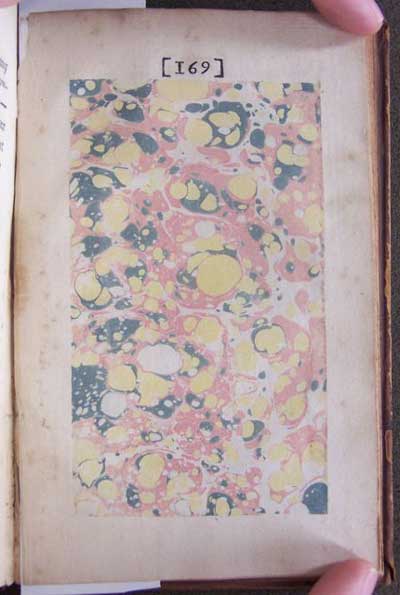
I recommend listening to it over at Slate. It’s the antithesis of Broderick’s technique, but a product of almost identical motivations. Consider, in the light of this, not necessarily the lead-up to Sterne’s infamous marbled page, his most elegant pause-for-thought – ‘you will no more be able to penetrate the moral of the next marbled page (motly emblem of my work!) that the world with all its sagacity has been able to unravel the many opinions, transactions and truths that still lie mystically hid under the dark veil of the black one’ – but its extraordinary aftermath: ‘My nose has been the making of me’ etc.

Lolita

You want a literary equivalent of Debussy’s pausing faun, written into the very cadence of a sentence, physically tangible whether you read it in your head or with your mouth? How about the tiny silences of this:

Lolita, light of my life, fire of my loins. My sin, my soul. Lo-lee-ta: the tip of the tongue taking a trip of three steps down the palate to tap, at three, on the teeth. Lo. Lee. Ta.

The Dream Songs

You want a literary equivalent of Morandi’s big fucking walls? Try reading the following as though you would read, I don’t know, smoothed iambic pentameter:

–Black hair, complexion Latin, jewelled eyes
downcast…The slot beside her       feasts…What wonders is
she sitting on, over there?

See, I always used to read these Tab­-like holes in the Dream Songs as gashes, as chunks of language that’d been taken out of Henry. But now I see Berryman has placed them there, as extra obstacles besides the awkwardness, futility and so on that haunt Henry’s experience. Berryman is making life difficult for Henry at the conception, rather than the expression stage. It’s all gloriously self-defeating, rather than self-lacerating.

Cummings


Or is it? Is it not also therapeutic? As Peter Broderick whispers, time heals all wounds. Time heals all tunes. Silence heals wounds. Spaces heal tunes.

E.E. Cummings is capable of sculpting a ‘body’s idiom’ in a way his peers are not because he composes ‘curves’ out of ‘yellows, angles or silences.’ He is repairing the failures of his prolix predecessors by allowing for the spaces beyond which, ironically, ‘nothing is.’ He is changing and saving himself:

some ask praise of their fellows
but i being otherwise
made compose curves
and yellows, angles or silences
to a less erring end)

myself is sculptor of
your body’s idiom:
the musician of your wrists;
the poet who is afraid
only to mistranslate

a rhythm in your hair,
(your fingertips
the way you move)
                             the

painter of your voice—
beyond these elements

remarkably nothing is....

It is this concept that makes Broderick’s use of silence so breathtaking, I think. For having established that it is precisely time – or perhaps time stopping – that changes art for the better, that heals, that forges lasting friendships, he stops himself for a couple of seconds. And sits. And listens. And in doing so, changes his song from within, in ways he couldn’t possibly enact from the irrelevant silences without.

Sam Kinchin-Smith
Music Editor

Tuesday, 18 January 2011

Beer/Bear | Poetry | Right Down to the Bone


“Finding new readers can be a full-time occupation, and like cold calling, is not for the faint-hearted. Whatever you do, don’t drink.”
- Chris Hamilton Emery, 101 Ways to Make Poems Sell

“I’ve had eighteen straight whiskies. I think that’s a record.”
- Dylan Thomas (plinyism)

Poetry and alcoholism. They’ve always been connected, haven’t they? Along with the poverty, promiscuity and paleolatry, we want that image of the male poet as a sad lonely booze-hound, crying into his tumbler whilst scribbling away at a profound, immaculate first draft.

Willmott had his wine, Thomas had his whiskey, Berryman had his gin and Bukowski had his beer.

The reasons for this correlation between poetry and alcoholism are an interesting point for speculation. There is the depressive element obviously, not that all poets are depressed but the cathartic benefits of creativity do tend to attract those poor folks with all the demons and baggage and black dogs and such don’t they?

And then there’s the poverty to consider. As the graph below shows, poets living under impoverished circumstances are far more susceptible to alcoholism than any other demographic:

Oh so you want to argue with Science now, do you?

This is caused partly through the self-perpetuating image of the steaming poet, and partly because alcohol is commonly perceived as a shortcut to warmth, sleep, self-esteem, sophistication and sexual prowess in lieu of the luxury amenities that we capitalists usually use to hike our way up Maslow’s pyramid.

My main association of booze with poetry, however, is that being drunk seems to be one of the only socially acceptable paths to automatic writing, and anyone who has ever suffered the feeling of being a dried up, muse-less poet will tell you that sometimes automatic writing is your only weapon against a blank page.

Sure, some people do this with marijuana, but it stinks, bums people out for hours afterwards, leads to obnoxiously pseudo-profound conversations and is, well, um, illegal. And then there’s the old fashioned method of simply counting backwards from one hundred whilst writing as ferociously as your subconscious will move your hand across the page. Which works, don’t get me wrong, but you look a bit weird doing it in polite company.


But a beer. Alone in a pub. With nothing but a thoughtful grimace and a notebook. Now that’s the poetry we know and love. By this point you’ve got the uninhibited frankness of thought and the necessary arrogance to kick aside all thoughts of futility and write some real world-changing stuff. Or at least you may find that, amongst your pages of drunken idiocy you might be able to salvage an aesthetically pleasing phrase or two. Before getting the night bus home and being sickened by everyone around you for doing all that fakery like having friends and being happy and stuff.

I might add that none of these is in any way a valid substitute for just, you know, reading lots of poetry and doing writing exercises and forming lucid, sober friendships with other creative types who are happy to swap bits of writing with you. But when you do follow this method and hit the big time, make sure you have enough well-rehearsed anecdotes of how you wrote your Forward Prize Winning collection after waking up in the alleyway outside Spearmint Rhinos. That'll show all those phoneys.

Anyway, in writing this article, I have been wrestling with the fact that I will never have anywhere near as much to say on the topic of poetry and alcoholism as the very poster-child for this relationship, one Mr. Charles Bukowski.


Because it is one of the finest documentaries on a poet that I have ever watched, I have embedded here, the entire 2 hours of the fantastic documentary ‘Born Into This’, charting the rise, fall and horrific personality of the poet who turned drunkenly line-breaking sparse prose into a movement.

Please excuse however, the presence of Bono in this documentary. Seriously. Bono. He smugly refers to Bukowski as ‘Hank’ as if to connote some sort of deep friendship and mutual respect between them.

He poncily postulates through his pretentious glasses:

“I started to discover a new kind of writing which had a kind of directness, aside from the beats which is what I grew up with… He’s got no time for metaphor, let’s just get right down to the bone, to the marrow of the bone.”

I’m sorry Bono, but last time I checked, 'getting right down to the bone' is a god damned metaphor.

Ignore Bono though, enjoy the documentary, for there ain’t many like it.

Phil Brown
Poetry Editor

Born Into This

Part 1


Part 2


Part 3


Part 4


Part 5


Part 6


Part 7


Part 8


Part 9


Part 10


Part 11


Part 12

Wednesday, 4 August 2010

Bees | Music | Blow Job Betty

Nick
Cave
’s Grinderman side-project has been universally described, alongside The Death of Bunny Munro, as the noises a mad-gifted man makes when he grows old disgracefully. And No Pussy Blues, the former’s best-known track (‘I thought I’d try another tack / I drank a litre of cognac / I threw her down upon her back / But she just laughed, and said she just didn’t want to…I got the no pussy blues’) not to mention the opening paragraphs of the latter’s third chapter (‘beached pussy prostrate beneath the erotically-shaped cumulus, loads of fucking girls are up for it, big ones, little ones, black ones, white ones, young ones, old ones, give-me-a-minute-and-I’ll-find-your-beauty-spot ones’) make it pretty bloody easy to see why.


Actually, Cave is growing old considerably less disgracefully than, I don’t know, Ronnie Wood, with his face like a smoker’s lung and his soggy phallus not even wedged between the thighs of a Kazakhstan-born teenager anymore. Cave is happily married to that lady off-of the front of the Roxy Music best-of. Cave has charming twin boys who play silly games with the Bad Seeds. The middle-aged Cave is, really, only as disgraceful as the sexual content in his work – by which token Craig Raine, Sebastian Faulks and innumerable other joylessly gentile writers can also be considered dirty old men.

Which does a disservice to dirty old men the world over, right? Cave only gets this shit because he has a beautiful moustache.

Anyway. What’s important here is that an important facet of Cave’s latter-day ‘disgracefulness’ is a casual misogyny that manifests, time and time again, in the phraseology he uses to address babes. And at least twice on the first Grinderman record, this means references to his ‘honey bee’. Harmless enough, until the context is thrown into the mix:

…She’s my honey bee and here she comes
Cancer rabies SARS
Hairy beards and hurtling stars
Won’t somebody touch me?
Honey bee lets fly to Mars
Buzzzzz buzzzz buzzzzz…

On second thoughts, maybe this song isn’t about a chick after all. But we’re too far in to worry about that. It being Bee Week, then, and what with my Silkworms column increasingly resembling a weekly celebration of Nick Cave, here be a Honey Bee Let’s Fly To Mars-inspired celebration of borderline-sexist slash reallyreallysexist approached to addressing women in poetry and music. Derek Walcott and his wandering hands would surely approve...


Pitchfork did such an unsurpassably good job of rinsing the first Louis XIV record (astonishingly, there was a second) penning it in the form of a conversation between singer Jason Hill and his doctor…

-Good morning, Mr. Hill.
-Doctor Bolend, what's going on man! It’s been too long, man.
-Long indeed, Mr. Hill.
-Almost as long as my dick!
-That’s nice, Mr. Hill. Looking at your file, I see it’s been three years since your last check-up. How have you been feeling?
-Better than ever man. I'm so healthy I can drink more than pregnant hookers in heat. I’m so ripped I can stick needles in my arms, then stick needles in my needles’ arms. I’ve fucked so many girls in the last five minutes that I’m gonna be orgasming straight through May. And don’t even get me started about how many girls I’ve fucked in the last five minutes.

…that I’m going to list some of the terms of feminine address in their biggest hit, Finding Out True Love Is Blind, and leave it at that:

‘Chocolate girl’
‘Your little Asian friend’
‘Carrot juice’
‘Your vanilla friend’
‘Miss little smart girl with your glasses and all your books’
‘Brown girl’

Und so weiter.

John Berryman’s Dream Song No. 4

Filling her compact & delicious body
with chicken paprika, she glanced at me
twice.
Fainting with interest, I hungered back
and only the fact of her husband & four other people
kept me from springing on her

or falling at her little feet and crying
‘You are the hottest one for years of night
Henry’s dazed eyes
have enjoyed, Brilliance.’ I advanced upon
(despairing) my spumoni. –Sir Bones: is stuffed,
de world, wif feeding girls.

–Black hair, complexion Latin, jewelled eyes
downcast…The slob beside her     feasts … What wonders is
she sitting on, over there?
The restaurant buzzes. She might as well be on Mars.
Where did it all go wrong? There ought to be a law against Henry.
–Mr Bones: there is.

The entire Mötley Crüe back-catalogue

The following are the lyrics to the Girls, Girls, Girls (1987) track All In The Name Of… I suspect the, turns out, criminally amoral Mötley Crüe could do and did do better than ‘honey bee’ but unfortunately I can’t bring myself to listen to their awful, awful songs:

She’s only fifteen
She’s the reason – the reason that I can't sleep
You say illegal
I say legal’s never been my scene
I try like hell but I'm out of control

All in the name of rock ‘n’ roll
For sex and sex I’d sell my soul

Pretty, pretty so innocent
She says you ain’t seen nothing yet
Brings me a dirty, dirty magazine
There she was for all the world to see
I try like hell but I’m out of control. All in the name of rock ‘n’ roll
For sex and sex I’d sell my soul

Says to me daddy
Can I have some candy
Wanna be your nasty
Anytime you want
You know you can have me

All in the name of rock ‘n’ roll
.

The entire Charles Bukowski back-catalogue

Extract from The Most Beautiful Woman In Town from 1983’s The Most Beautiful Woman In Town & Other yaaaaaaaaaaaaaaaaaaaaaaaaaaaaaaaaaaaaaaaaaaawwwwn:

Cass was the youngest and most beautiful of 5 sisters. Cass was the most beautiful girl in town. 1/2 Indian with a supple and strange body, a snake-like and fiery body with eyes to go with it. Cass was fluid moving fire. She was like a spirit stuck into a form that would not hold her. Her hair was black and long and silken and whirled about as did her body. Her spirit was either very high or very low. There was no in between for Cass. Some said she was crazy. The dull ones said that. The dull ones would never understand Cass. To the men she was simply a sex machine and they didn't care whether she was crazy or not. And Cass danced and flirted, kissed the men, but except for an instance or two, when it came time to make it with Cass, Cass had somehow slipped away, eluded the men…

Lord Byron’s objectifications

As everybody knows, where literature was concerned, Byron was only in it for the snatch. She who Walks In Beauty, not to mention Lara and his Beautiful Quaker – that shit’s obvious. More interesting is the fact that when he’s talking about Newstead Abbey and The Vision Of Judgement, he’s almost certainly still thinking about the puss.

But all of these pale into insignificance when placed alongside the frankly extraordinary thing that is Too $hort’s Blow Job Betty. As one youtube commenter put it, ‘I love this dude. He’s the reason white women over 30 hate rap.’ Bukowski, you, sir, are a pussy compared to this guy (actually, LyricsFreak seems to suggest, shockingly, that the below is the work of five different hands…)

…Too $hort baby, I'm so hard
Pimpin' these hoes on the boulevard
But I'm not here to tell ya bout me
I got a little story bout a nasty freak
She's the kind of girl you think about in bed
Blowjob Betty givin' real good head
Bust a left nut, right nut in her jaw
Sperm on her cheeks is all ya saw
She could blow more head than a whale blows water
Blowjob Betty make your dick get harder
She's a one of a kind, a hell of a girl
A trip and a half around the world
Catch her gettin' busy, bitch wouldn't stop
She's the kind of girl that'll make your toes pop
Every time I used to see her, I would know what's up
Blowjob Betty better blow me up
I remember the day when I first met her
Bitch kinda loose so I knew I'd get her
Walked up to her said
"my name is $hort, just what
you've been lookin' for"
Pimp is my game, I do it the best
Hoe fuck with me, she don't get no rest
Well after that, I G'ed the freak
I used to stop by and fuck about twice a week
And from the very first time I went to her house
Walked in the door and stuck my dick in her mouth
$hort Dog'll get bitches anytime I wanna
Got a big dick and lay it right on her tonsils
Only stick it in about half way back
Cause if I put it all in, it bust straight through her neck…

The likes of the above examples, ladies and gentleman of the jury, testify to the fact that Colony Collapse Disorder constitutes the great ecological challenge of our time. A world without the honey bee would be a world without misogyny. To work, then!

Sam Kinchin-Smith
Music Editor

Saturday, 31 July 2010

Are you radioactive, pal?


A couple of years ago I managed to get my hands on a copy of a recording of John Berryman and Robert Lowell reading together. To this day it is one of the most listened to things on my iPod. Berryman really knew how to read his poetry out loud. He knew that your audience needs it nice and slow. And honest. Not a whiff of that god-awful 'poetry voice' you hear so many others doing... JB's the real deal.

If only there were more footage of him. Still, we have to be grateful for the ready availability of this interview with Al Alvarez, and this superb reading of one of the Dream Songs.

Most disturbing and beautiful of all, however, is this superb hour-long interview with a semi-coherant Berryman:


There is also this series of audio recordings:


EDIT... 31st July 17:07

Any creative writing students, or indeed anyone interested in Lowell and/or Berryman will find this interview with Philip Levine fascinating... he discusses the two poets' style of teaching creative writing. I get the impression he preferred Berryman.